
Neoclouds Explained: Why AI Is Building a New Cloud Market
AI changed the software industry. Now it is changing the cloud.
How AI Is Changing the Software Development Lifecycle
For years, businesses largely thought about cloud computing through platforms such as AWS, Microsoft Azure, and Google Cloud. But artificial intelligence is creating a new infrastructure requirement: enormous amounts of GPU compute, high-speed networking, specialized storage, and infrastructure designed specifically for AI workloads.
That is where neoclouds enter the picture.
Instead of trying to provide hundreds of cloud services for every possible workload, neocloud providers focus on one increasingly valuable requirement: high-performance computing for AI.
And this is creating a new market within cloud computing.
A neocloud is a specialized cloud provider built primarily for AI and high-performance computing workloads.
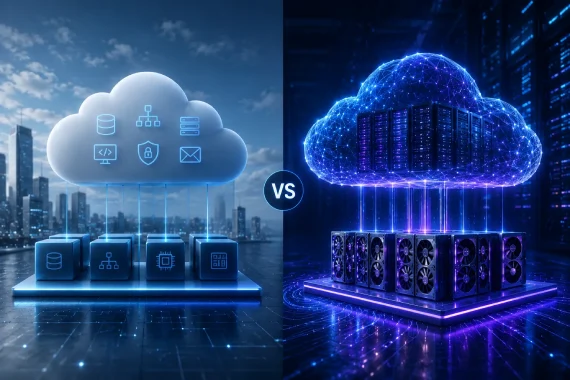
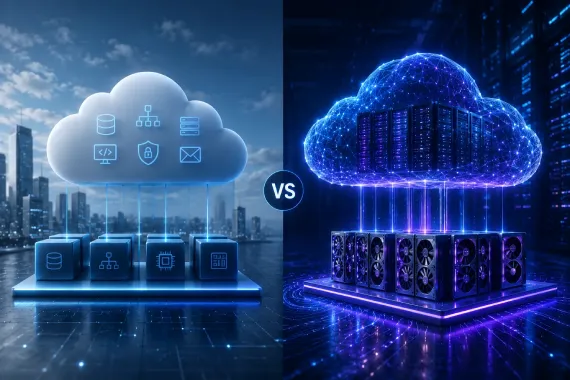
Traditional cloud platforms are designed to support everything from websites and databases to enterprise applications and analytics. Neoclouds take a more focused approach, offering GPU-accelerated infrastructure optimized for workloads such as:
- AI model training
- Generative AI
- Machine learning
- Model fine-tuning
- Large-scale AI inference
- High-performance computing
Traditional cloud: “Here are hundreds of services for almost anything.”
Neocloud: “Here is highly optimized computing power for demanding AI workloads.”
Providers in this emerging category include companies such as CoreWeave, Nebius, Crusoe, Lambda and others. The category is still evolving, but its purpose is becoming increasingly clear: provide specialized AI compute at scale.

Why Did Neoclouds Suddenly Become Important?
Faster access
Training and running large AI models can require thousands of GPUs working together, extremely fast networking, significant power and cooling capacity, and specialized infrastructure.
Built for scale
Traditional cloud providers are responding by expanding their AI infrastructure. However, demand for advanced GPU capacity has grown so quickly that specialized providers have found an opportunity.
A market in motion
According to Synergy Research Group, neocloud revenue exceeded $25 billion in 2025, with Q4 revenue reaching $9 billion. The firm forecasts the market could approach $400 billion by 2031.
This isn’t simply another cloud trend. AI is creating demand for an entirely different type of infrastructure.
THE COMPARISON
Neocloud vs Traditional Cloud: What’s the Difference?
AI-native development brings enormous potential, but moving fast without controls can create new problems.
| Traditional Cloud | Neocloud |
|---|---|
| General-purpose infrastructure | AI-focused infrastructure |
| Broad range of cloud services | Specialized compute services |
| CPU + GPU workloads | Primarily GPU/accelerated workloads |
| Large managed-service ecosystem | Focus on AI infrastructure |
| Built for many application types | Built around AI/HPC workloads |
| Maximum service breadth | Maximum AI compute specialization |
Neoclouds aren't necessarily replacing hyperscalers. In many enterprise environments, the future could be multi-compute: traditional cloud for general applications, neoclouds for large AI workloads, and edge or on-premises infrastructure for specific latency, security or data-residency requirements.
THE BUSINESS CASE
Why Businesses Are Looking at Neoclouds
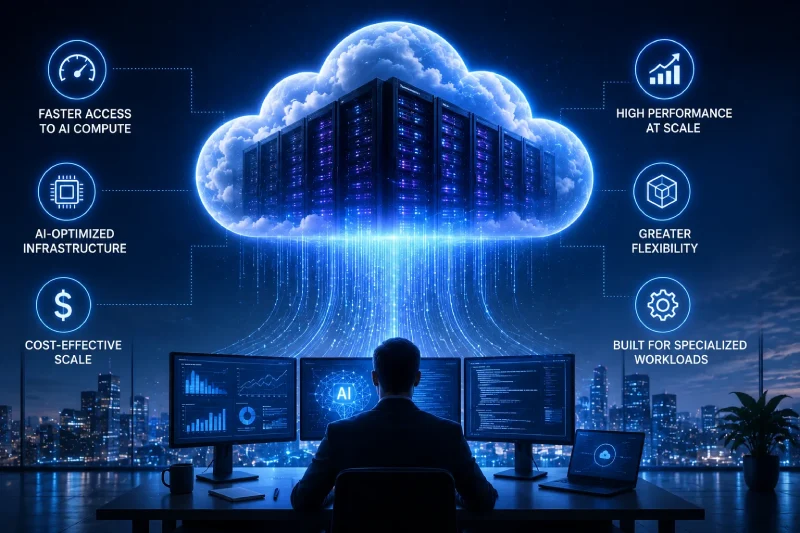
Faster Access to AI Compute
Neoclouds are designed around accelerated computing, making them particularly attractive when organizations need large GPU clusters for training or inference.
AI-Optimized Infrastructure
Their infrastructure is purpose-built around AI requirements, including high-performance networking, GPU clusters and optimized compute environments.
Greater Infrastructure Flexibility
Businesses can access specialized computing capacity without necessarily building their own AI data-center infrastructure.
Better Fit for Specialized Workloads
An organization training large models has very different infrastructure requirements from a company running a conventional web application. Neoclouds are designed around that difference.
But Neoclouds Aren't Right for Everything
The excitement around neoclouds should not lead businesses to assume that they are automatically better than hyperscalers.
Traditional cloud platforms still offer enormous advantages in areas such as:
- Managed databases
- Serverless computing
- Enterprise application services
- Analytics
- Identity and security services
- Global infrastructure
- Broad developer ecosystems
Neoclouds generally have a narrower service portfolio because specialization is their strength.
The real question for businesses is therefore not:
“Should we move to a neocloud?”
It is:
“Which workloads actually benefit from specialized AI infrastructure?”

LOOKING AHEAD What This Means for the Future of Cloud Computing
The cloud market is entering a new phase.
For years, cloud competition was largely about scale, services, regions and flexibility. AI is adding new dimensions:
That means the next generation of cloud infrastructure may be less about one provider doing everything and more about choosing the right infrastructure for each workload.
AI is not only changing how software is built.
It is changing the infrastructure underneath that software.
As AI moves from experimentation into production, businesses will increasingly need to evaluate GPU infrastructure, cloud architecture, AI workloads, data requirements, security and cost together.
Neoclouds are one important part of that transformation.
The future may not belong exclusively to hyperscalers or neoclouds. It may belong to businesses that know when to use each one.

Frequently Asked Questions
What is a neocloud?
A neocloud is a specialized cloud infrastructure provider focused primarily on high-performance computing for AI, machine learning and other demanding workloads.
How is a neocloud different from AWS or Azure?
AWS and Azure provide broad cloud ecosystems covering many types of workloads. Neoclouds generally focus more narrowly on GPU-accelerated computing and AI infrastructure.
Why are neoclouds growing?
The rapid growth of AI has created huge demand for GPUs, high-speed networking and specialized computing infrastructure. Neoclouds are designed specifically to address these requirements.
Are neoclouds replacing traditional cloud providers?
Not necessarily. Neoclouds are more likely to complement traditional cloud platforms. Businesses may use hyperscalers for general workloads and specialized providers for demanding AI workloads.
Are neoclouds cheaper than traditional cloud?
Not automatically. Cost depends on workload type, GPU requirements, utilization, networking, storage, contract terms and infrastructure configuration. Businesses should compare total workload economics rather than GPU hourly rates alone.
The right infrastructure makes AI ambition practical.
Start a conversation about your next AI workload.