
Multi-Agent AI Systems Explained: When One AI Agent Isn't Enough
AI is getting smarter. But the bigger breakthrough may be getting AI agents to work together.
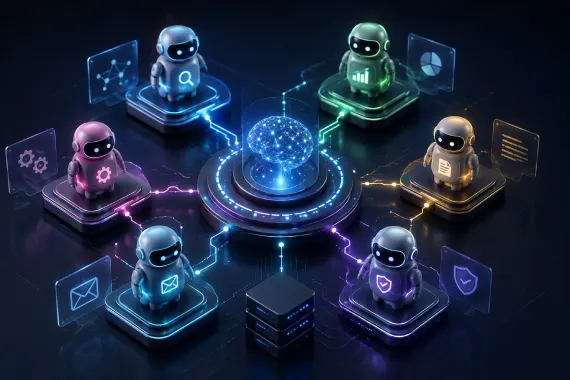
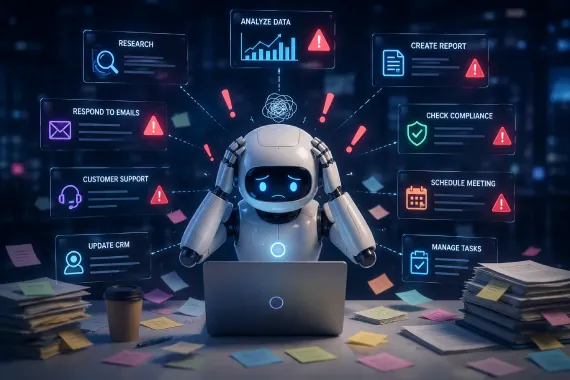
Imagine asking one AI system to research a market, analyze the findings, check compliance, prepare a report, update your CRM and send the final recommendation.
It can try to do everything.
But should it?
As businesses move from simple AI chatbots to AI systems that can reason, use tools and execute tasks, a new architecture is emerging: multi-agent AI systems.
Instead of asking one AI agent to handle every responsibility, businesses can use multiple specialized agents that collaborate, delegate tasks and share information.
That shift could fundamentally change how enterprise software and automation are built.
What Is a Multi-Agent AI System?
A multi-agent AI system is a group of specialized AI agents that work together to accomplish a larger goal.
Think of it like a digital team.
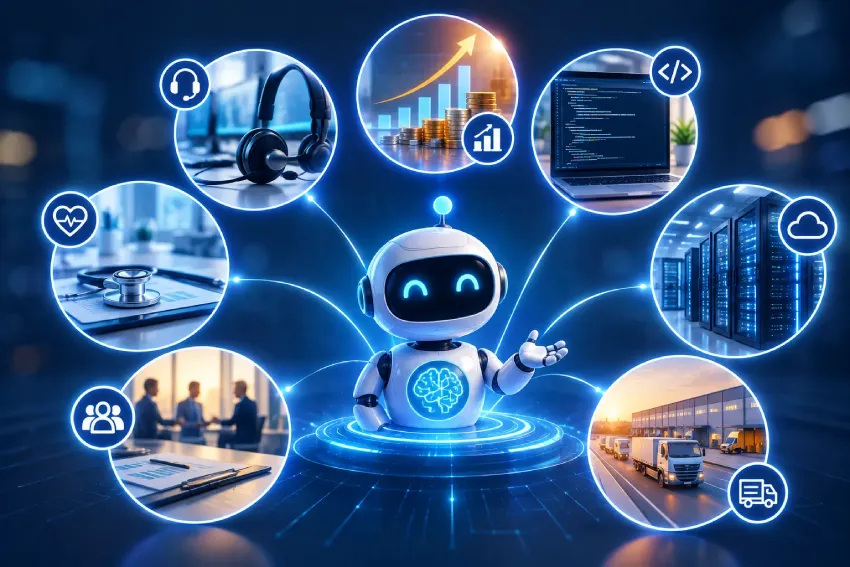
Instead of one employee handling research, finance, operations and customer communication, different specialists handle different responsibilities.
For example:
Each agent has a defined role, access to specific tools and a particular responsibility.
The orchestrator coordinates the work and determines which agent should act next.
This makes multi-agent AI particularly useful for complex workflows that involve several systems, decisions or areas of expertise.
Multi-agent systems are now recognized as one of Gartner's strategic technology trends for 2026, with the focus moving toward modular AI agents that collaborate on complex tasks.
Why Isn't One AI Agent Enough?
A single AI agent can be extremely capable.
But giving one agent too many responsibilities can create problems.
Too Much Context
An agent handling sales, finance, HR and IT simultaneously has to process very different information. As responsibilities increase, maintaining the right context becomes harder.
Specialized Tasks Need Specialized Expertise
A financial analysis agent may need different tools, rules and data than a customer-support agent. Separating these responsibilities can make the overall system easier to control.
Different Permissions
Should a customer-service AI be allowed to modify financial records? Probably not. With multiple agents, organizations can define role-based access and permissions according to each agent’s responsibilities.
Easier Monitoring
If something goes wrong, it is easier to identify whether the problem came from the research agent, decision agent or execution agent than from one massive AI workflow.
Parallel Work
Multiple agents can potentially work on different parts of a task simultaneously. Instead of: Research → Analysis → Verification → Report a system could execute several independent activities at the same time and bring the results together.
UNDER THE HOOD
How Does Multi-Agent AI Actually Work?
A typical multi-agent architecture contains several important components.
The Orchestrator
The orchestrator acts like a project manager. It understands the overall objective, breaks it into tasks and decides which agent should handle each task.
Specialized Agents
Each agent focuses on a particular responsibility.
Research Agent → Finds and summarizes information
Data Agent → Retrieves and analyzes business data
Finance Agent → Performs financial calculations
Compliance Agent → Checks policies and regulations
Communication Agent → Creates emails, reports or customer responses
Tools and Systems
Agents become useful when they can interact with real systems.
They may connect to:
Shared Context
Agents need a reliable way to exchange information. The system must determine what information is passed between agents, what should be remembered and what should remain isolated.
Governance and Monitoring
This becomes critical in enterprise environments. As organizations deploy more agents, they need visibility into what agents are doing, what systems they access and whether their actions comply with business policies.
IBM's 2026 technology roadmap highlights this transition toward multi-agent systems while emphasizing AgentOps, monitoring, orchestration and security as organizations move agents into production.
IN PRACTICE
A Simple Real-World Example
Consider an enterprise procurement process.
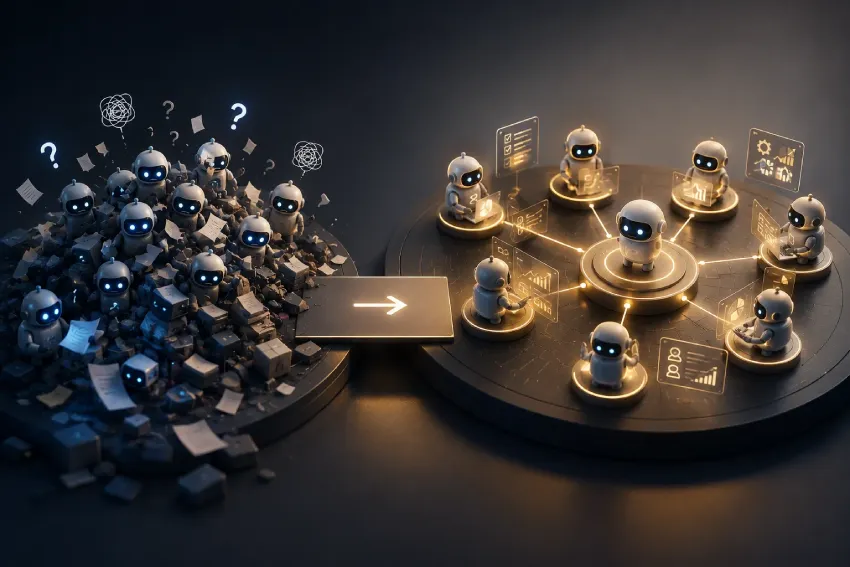
A company receives a request to purchase new software.
Procurement Agent
Receives the request and starts the workflow.
Research Agent
Finds suitable vendors and compares products.
Finance Agent
Checks the budget and calculates the expected cost.
Security Agent
Evaluates cybersecurity and data-privacy requirements.
Compliance Agent
Checks whether the vendor meets internal policies.
Decision Agent
Combines the findings and recommends an option.
Execution Agent
Creates the purchase request or sends it for human approval.
Where Can Businesses Use Multi-Agent AI?
The possibilities extend across almost every enterprise function.
Customer Experience
One agent can understand the customer’s problem while others retrieve account information, troubleshoot the issue and recommend the next action.
Software Development
Agents can collaborate on requirements, coding, testing, security review and documentation.
Finance
Agents can retrieve financial information, analyze transactions, identify anomalies and prepare reports.
IT Operations
Agents can monitor systems, investigate incidents, identify potential causes and recommend or execute remediation steps.
Sales
A research agent can identify prospects, another can analyze account information, while another prepares personalized outreach.
Supply Chain
Agents can monitor inventory, analyze demand, identify disruptions and recommend procurement actions.
Multi-Agent AI Isn't Just About Adding More AI
- More complexity
- More infrastructure
- More API calls
- More opportunities for errors
- More security concerns
- More difficult debugging
- More governance requirements
IBM notes that enterprises moving toward multi-agent workflows need to address issues such as agent sprawl, cascading errors, excessive resource consumption and governance.
Better orchestration.
The Future: From AI Assistants to AI Teams
The first phase of enterprise AI was largely about asking AI questions.
The next phase is about giving AI responsibilities.
And increasingly, those responsibilities may be distributed across teams of specialized agents.
Enterprise technology providers are already investing in multi-agent orchestration and centralized controls for deploying, governing and scaling agents across organizations.
The important question for businesses is no longer simply:
“Can we use AI?”
It is becoming:
“Which parts of our business should AI agents handle, and how should those agents work together safely?”
That is where multi-agent AI becomes more than a technology trend.
It becomes an architecture for the next generation of intelligent enterprise software.
Frequently Asked Questions
What is a multi-agent AI system?
A multi-agent AI system consists of multiple specialized AI agents that collaborate to complete a larger task or business workflow. Each agent can have its own role, tools, permissions and responsibilities.
What is the difference between an AI agent and a multi-agent system?
An AI agent typically handles a task or workflow independently. A multi-agent system connects multiple agents so they can divide responsibilities, exchange information and coordinate actions.
Why use multiple AI agents instead of one?
Multiple agents can specialize in different tasks, operate with different permissions, work in parallel and make complex workflows easier to manage and monitor.
Are multi-agent AI systems suitable for businesses?
Yes. They can be useful for complex workflows in areas such as customer service, IT operations, software development, finance, sales, procurement and supply-chain management.
Are multi-agent AI systems secure?
They can be designed securely, but they introduce additional risks. Organizations need appropriate identity management, permissions, monitoring, sandboxing, human oversight and governance.
Do multi-agent systems replace employees?
Not necessarily. Their primary value is often augmenting teams by automating repetitive or complex digital workflows while allowing people to focus on decisions requiring judgment, creativity and accountability.
When should a company consider multi-agent AI?
A company should consider it when a workflow contains multiple specialized tasks, systems, decisions or sources of information that would benefit from coordinated AI capabilities.
The future of AI may not be one super-intelligent agent doing everything.
It may be a coordinated team of specialized agents — each good at one thing, connected through an intelligent orchestration layer and governed by the organization.
For businesses exploring AI automation, the opportunity is not simply to deploy another chatbot.
It is to rethink how work gets done.
One agent can answer. A coordinated team of agents can execute.
That distinction could define the next generation of enterprise AI.