
The Hidden Security Risk of AI Agents: What Happens When AI Gets Access to Your Systems?
AI agents can read, decide and act. But what happens when they have access to the systems your business depends on?
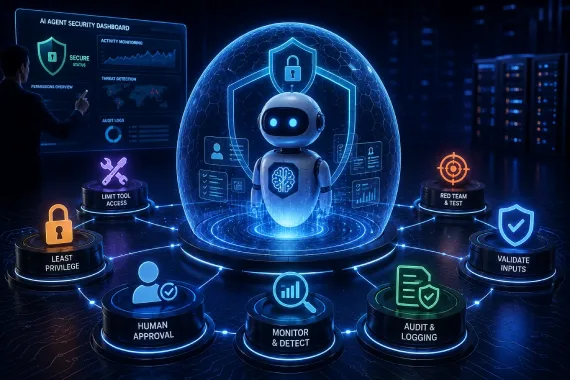
AI is no longer limited to answering questions. Modern AI agents can interact with applications, retrieve information, call APIs, execute workflows and take actions on behalf of users.
That is what makes agentic AI so powerful.
It is also what makes it a security concern.
An AI chatbot that gives you the wrong answer is frustrating. An AI agent with excessive permissions that makes the wrong decision could potentially expose data, modify records, send communications or trigger actions that were never intended.
The question businesses need to ask is no longer simply “Can we use AI?”
It is:
“What should our AI be allowed to do?”
01 AI Agents Are Different From Traditional Chatbots
A traditional chatbot generally waits for a question and generates a response.
An AI agent can go several steps further:
For example, imagine an AI agent connected to a company’s internal systems.
A user asks:
“Find all overdue customer invoices and send reminders.”
The agent might access the CRM, retrieve financial information, identify overdue accounts, generate emails and send them through an email platform.
The productivity benefits are obvious.
But now imagine that the agent has access to more data, APIs and permissions than it actually needs.
A mistake, manipulated instruction or compromised data source could potentially turn a productivity tool into a security risk.
OWASP describes this problem as excessive agency, where excessive functionality, permissions or autonomy can allow an AI system to perform harmful actions.
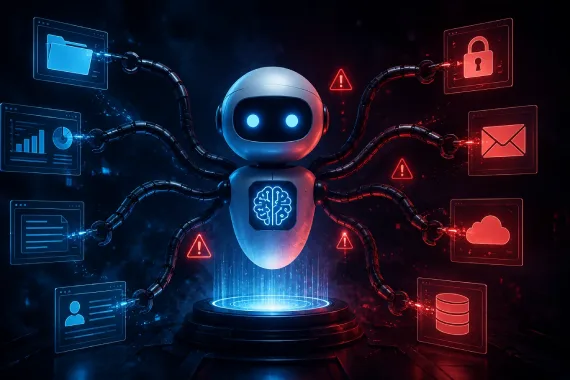
02 The Hidden Risk: AI Can Be Given Too Much Power
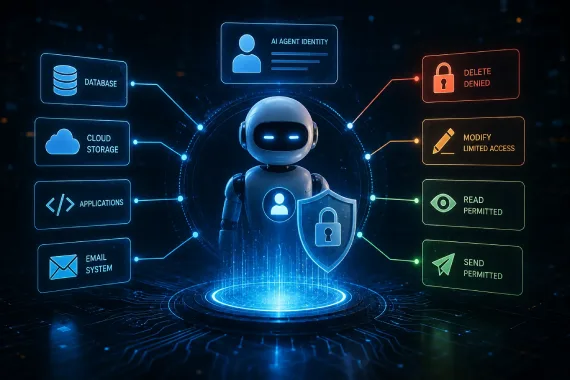
The biggest security mistake may not be the AI model itself.
It may be what the AI is allowed to access.
An AI agent could potentially be connected to:
- Customer databases
- CRM systems
- Cloud storage
- Internal documents
- Financial applications
- APIs
- HR systems
- Development environments
- Business automation platforms
If an agent only needs to read customer information, why should it also be allowed to delete records?
If it needs to draft an email, why should it automatically have permission to send one?
If it needs to retrieve a report, why should it have access to an entire database?
This is where the traditional security principle of least privilege becomes critical for AI agents.
Give an agent only the permissions it needs—and nothing more.
03 Prompt Injection: The Instruction You Didn't Expect
One of the more unusual AI security risks is prompt injection.
An AI agent may process information from emails, documents, websites, tickets or other external sources.
That information can contain instructions designed to manipulate the agent.
An innocent-looking document can carry a hidden instruction that changes what an agent does next.
For example, an agent may be asked to summarize a document. Hidden inside that document could be malicious instructions attempting to make the agent perform an unrelated action.
The danger becomes much greater when the agent has access to business tools.
Instead of simply producing incorrect text, the manipulated agent could potentially attempt to:
NIST has specifically highlighted indirect prompt injection and agent hijacking as security concerns for agentic systems.
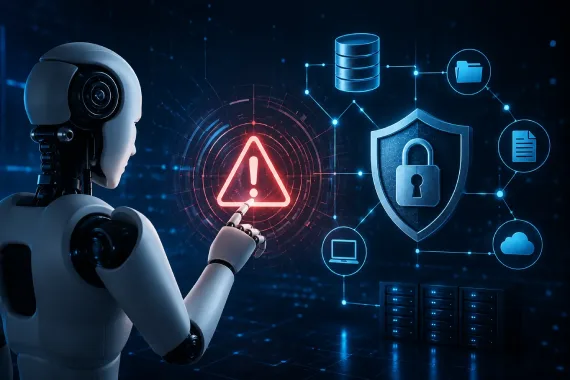
04 Your AI Agent Needs an Identity Too
There is another question businesses should start asking:
“Who is this AI agent?”
If an employee performs an action, the organization’s identity and access controls can determine who performed it.
But autonomous software agents introduce another identity and authorization challenge.
An enterprise may have dozens or hundreds of agents performing different tasks. Each one may require different access levels, credentials, tools and boundaries.
NIST has already identified agent identity, authorization, auditing and non-repudiation as important areas for securing software agents.
That means organizations need to think beyond:
Every step creates another security boundary.
05 Five Security Questions Every Business Should Ask
Map every application, database, API and data source.
Separate read, write, modify, delete and execute permissions.
Test scenarios involving prompt injection, malicious documents and compromised inputs.
Consider approval gates for financial transactions, data deletion, external communications and other sensitive actions.
Every important action should be traceable through logging, monitoring and audit trails.
These controls become increasingly important as agents move from experimental environments into real business workflows. OWASP’s current agent security guidance emphasizes strict tool scopes, authorization controls, monitoring, testing and adversarial validation.
06 How Businesses Can Secure AI Agents
Security should not be added after an AI agent is deployed.
It should be designed into the architecture.
Give each agent the minimum permissions required for its specific task.
Do not expose every available API or function to an agent. Only provide the tools it genuinely needs.
High-impact actions should require human confirmation wherever appropriate.
Treat emails, documents, websites and retrieved content as potentially untrusted inputs.
Track unusual tool calls, unexpected data access, repeated failures and abnormal activity.
Test how the agent behaves when it encounters malicious instructions, unexpected inputs or compromised tools.
Organizations should be able to answer:
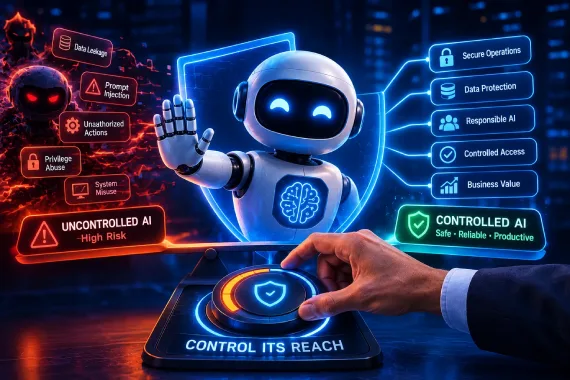
07 The Goal Isn't to Stop AI. It's to Control Its Reach.
AI agents can create enormous value for businesses.
They can automate repetitive processes, accelerate decision-making and connect systems in ways that traditional automation often cannot.
But autonomy without boundaries creates unnecessary risk.
The future of enterprise AI will therefore not simply be about building smarter agents.
It will be about building controlled, observable and secure agents.
The organizations that get this balance right will be able to automate more confidently—without handing an AI system unlimited access to their business.
AI should have enough access to get the job done.
Not enough access to become the next security incident.
Frequently Asked Questions
What is AI agent security?
AI agent security refers to the practices used to protect AI agents, their tools, identities, data, permissions and connected systems from misuse, manipulation and unauthorized actions.
Why are AI agents a security risk?
Unlike simple chatbots, AI agents can interact with external systems and take actions. Excessive permissions, tool access, autonomy or manipulated inputs can therefore increase the potential impact of an error or attack.
What is prompt injection in AI agents?
Prompt injection occurs when specially crafted instructions influence an AI model to behave in an unintended way. In agentic systems, the risk can increase when the model has access to tools or sensitive systems.
Should AI agents have access to production systems?
They can, but access should be carefully controlled. Businesses should use least-privilege permissions, restricted tools, monitoring, logging and human approval for high-impact actions.
How can companies secure AI agents?
Organizations can secure AI agents by controlling permissions, limiting tool access, validating external inputs, protecting credentials, monitoring behaviour, maintaining audit logs and regularly conducting security testing.
Can AI agents replace traditional cybersecurity controls?
No. AI security should complement—not replace—traditional cybersecurity practices such as identity management, access control, network security, application security, monitoring and incident response.
The biggest AI security question isn't "How intelligent is the agent?"
It's:
"How much power have we given it?"
As AI agents become connected to more enterprise systems, security teams need to treat agent identity, permissions, tools, data and actions as part of the organization's security architecture. For businesses adopting agentic AI, secure-by-design should come before autonomous-by-default.