
AI Governance in 2026: How Businesses Can Use AI Without Losing Control
AI is no longer just answering questions. It is writing code, analysing data, assisting employees, making recommendations and increasingly taking actions through AI-powered workflows.
But as AI becomes more autonomous, one question becomes harder to ignore:
Who is actually in control?
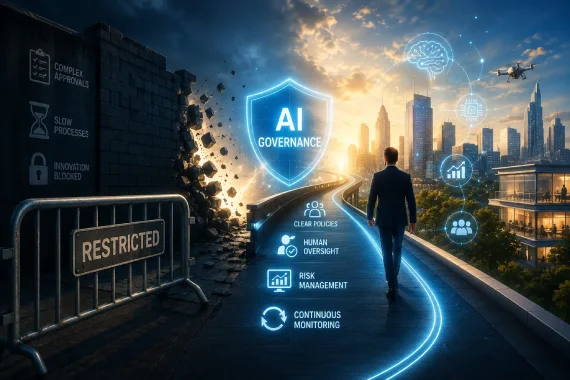
That is where AI governance comes in.
AI governance is no longer a policy document sitting in an IT department. In 2026, it is becoming an essential business capability for organisations that want to scale AI without exposing themselves to unnecessary security, compliance, privacy and operational risks.
AI Adoption Is Moving Faster Than AI Governance
Businesses are adopting generative AI, AI agents and automated decision-making at remarkable speed. But deploying an AI tool is only one part of the equation.
Companies also need to understand:
- What data does the AI access?
- Who is responsible for its output?
- What happens when the AI makes a wrong decision?
- Can employees use public AI tools with company information?
- How are AI systems tested and monitored?
- When should a human review an AI-generated decision?
- Does the AI system comply with applicable regulations?
The challenge is not to stop AI adoption.
The challenge is to make AI adoption controllable.
NIST's AI Risk Management Framework provides a useful model built around four continuous functions:

What Does AI Governance Actually Mean?
Think of AI governance as the control layer around your AI ecosystem.
It defines the policies, responsibilities, processes and technical safeguards that determine how AI can be developed, purchased, deployed and used. A practical AI governance framework should cover five areas:
Data Control
Know what information AI systems can access and where sensitive information is going. Organisations should establish clear rules around personal data, confidential business information, customer data and intellectual property.
Model & Tool Control
Not every AI model or application should automatically be approved for business use. Companies should evaluate models and vendors based on security, privacy, reliability, transparency and business risk.
Human Oversight
AI should not automatically make every important decision. For high-impact use cases, organisations need defined points where people can review, approve, override or stop AI-driven actions.
Monitoring & Accountability
AI governance cannot end when a system goes live. Organisations need continuous monitoring for accuracy, unexpected behaviour, security issues, bias, policy violations and changes in risk. NIST describes governance as a continuous, organisation-wide function that should be integrated throughout the AI lifecycle.
Compliance & Transparency
AI regulations are becoming increasingly important. For businesses operating across markets, AI governance therefore needs to consider both technology and regulatory requirements.

RISK-BASED BY DESIGN
How Can Businesses Use AI Without Losing Control?
The answer isn’t creating endless approval processes.
Instead, businesses can establish a risk-based AI governance model.
A low-risk AI tool used for drafting internal content may require basic approval and data controls.
An AI system making decisions that affect customers, employees, finances or sensitive information should receive significantly stronger testing, monitoring and human oversight.
This allows organisations to move quickly while maintaining appropriate controls.
THE DIFFERENCE
AI Governance Should Enable Innovation — Not Block It
“Don’t use AI until everything is approved.”Poor governance says:
“Here is how you can use AI safely.”Good governance says:
The goal of AI governance is not to create bureaucracy around every AI experiment. It is to give teams a clear operating framework so they know what they can use, what requires approval and where human oversight is mandatory.
When governance is designed properly, businesses can actually accelerate AI adoption because employees and technology teams have clearer boundaries.

The 2026 AI Governance Checklist
Before deploying an AI system, ask:
CENTER
If these questions do not have clear answers, the organisation may be moving faster than its governance.
The Future of AI Belongs to Controlled AI
The next competitive advantage will not simply come from companies that use the most AI.
It will come from companies that can scale AI responsibly.
As AI moves from assistants to autonomous workflows, governance will become part of the technology architecture itself — connecting data, models, applications, security, people and business policies.
For organisations adopting AI in 2026, the objective should be simple:
Nispaara Solutions can help businesses evaluate AI adoption, design secure AI workflows and build technology environments where innovation and governance work together.
Frequently Asked Questions
What is AI governance?
AI governance is the framework of policies, processes, responsibilities and technical controls that organisations use to manage how artificial intelligence is developed, deployed and used.
Why is AI governance important in 2026?
AI systems are becoming more capable and autonomous. Businesses therefore need stronger controls around data, security, accountability, human oversight, monitoring and regulatory compliance.
Is AI governance only for large enterprises?
No. Businesses of any size using AI can benefit from governance. The level of governance should depend on the risk, sensitivity and business impact of each AI use case.
Does AI governance stop employees from using AI?
No. Effective AI governance should establish clear rules for safe AI use rather than preventing employees from using AI altogether.
What should an AI governance framework include?
A practical framework should address AI use cases, data access, model and vendor assessment, security, human oversight, monitoring, accountability, documentation and applicable regulations.
What is the difference between AI governance and AI security?
AI security focuses primarily on protecting AI systems, models, data and infrastructure from threats. AI governance is broader and also covers accountability, policies, risk management, compliance, transparency and responsible use.
How can businesses start AI governance?
Start by creating an inventory of AI systems and use cases, classify them according to risk, establish ownership and approval processes, define data and security policies, and continuously monitor deployed systems.
AI without governance creates uncertainty. AI with governance creates scale.
The companies that succeed with AI in 2026 will not necessarily be the ones that adopt it first.
They will be the ones that learn how to innovate with AI while remaining firmly in control.