
AI Coding Agents in 2026: Are Developers Becoming AI Managers?
AI coding agents are changing software development from writing code line by line to directing, reviewing and validating AI-generated work. But does that make developers less important—or more strategic?
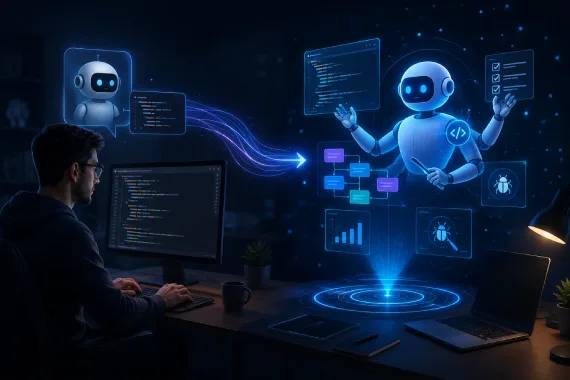
Software development is entering a new phase. AI coding tools are no longer limited to autocomplete or suggesting the next line of code. Modern coding agents can understand a task, work across a codebase, write and modify code, run tests, debug problems and prepare changes for human review. Gartner describes this shift as the move from AI-assisted development toward agentic software development across the software development lifecycle.
That raises an interesting question:
If AI can write the code, what exactly will developers do?
The answer may be: less typing, more directing.
THE NEW BASELINE
From Coding Assistants to Coding Agents
Traditional AI coding assistants mainly helped developers write code faster. A developer would ask for a function, receive a suggestion and decide whether to use it.
Coding agents work differently.
A developer can provide a high-level objective such as:
“Add authentication, update the API, write tests and fix any failing test cases.”
The agent can then break the task into smaller steps, interact with development tools, modify multiple files and validate its work.
This is why the industry is increasingly talking about agentic coding rather than AI-assisted coding. Gartner’s 2026 research identifies enterprise AI coding agents as a rapidly expanding market, with platforms increasingly coordinating complex workflows rather than simply generating snippets.

THE ROLE IS EVOLVING
So, Are Developers Becoming AI Managers?
Not exactly. But their role is changing.
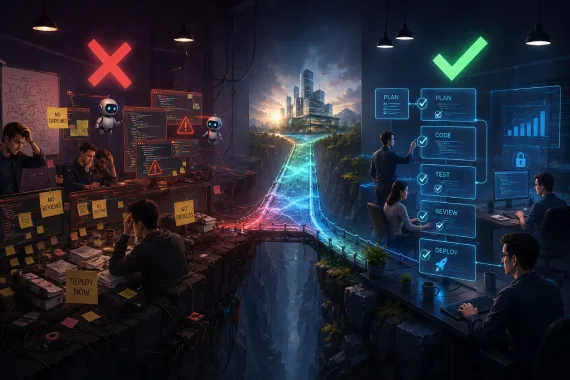
Developers are increasingly becoming orchestrators, reviewers and decision-makers.
Instead of spending most of their time manually producing code, developers may spend more time:
- Defining what needs to be built
- Giving AI agents the right context
- Designing system architecture
- Reviewing AI-generated code
- Testing and validating results
- Detecting security and performance issues
- Managing multiple AI agents
- Making important technical decisions
Recent research on professional developers found a shift from code creation toward verification activities, describing this emerging responsibility as “supervisory engineering work.”
In other words, the developer isn’t disappearing.
The developer is moving up the abstraction layer.
A NEW OPERATING MODEL
The New Software Development Workflow
The development process could increasingly look like this: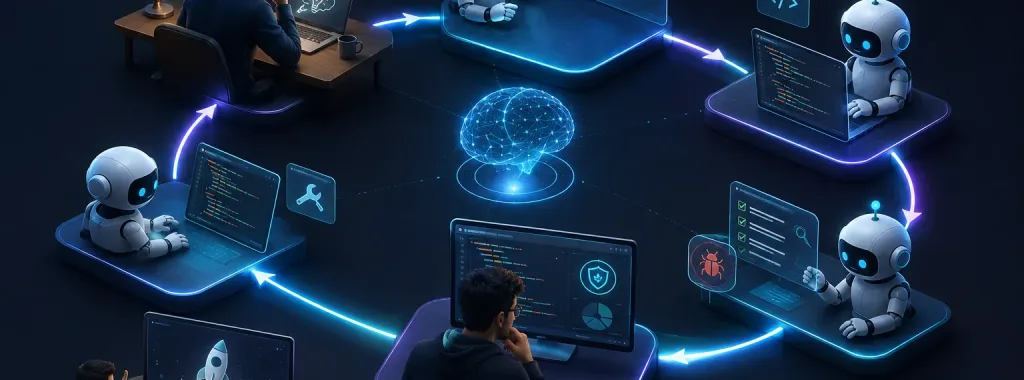
This doesn’t mean developers can simply “let AI code.”
AI-generated software still needs context, judgment and verification. A recent analysis of AI coding agents found that performance varies considerably by task type, reinforcing the importance of human oversight rather than assuming one agent is best at everything.
WHAT MATTERS NOW
What Skills Will Matter Most?
The most valuable developers of the AI era may not simply be those who can write the most code.
They will be the ones who can think clearly about software.
1. System Design
AI can generate components, but developers still need to understand how those components should fit together.
2. Code Review
When AI produces more code, the ability to identify bad architecture, hidden bugs and unnecessary complexity becomes even more valuable.
3. AI Orchestration
Developers will increasingly need to understand how to assign tasks to agents, provide context and coordinate multiple AI tools.
4. Security
More autonomous development means more opportunities for vulnerable code, unsafe dependencies or excessive permissions. AI coding therefore needs strong security and governance controls.
5. Business Understanding
The best technical solution isn’t always the one with the most sophisticated code. Developers who understand the actual business problem will be better positioned to guide AI effectively.

THE RISK
The Biggest Mistake Businesses Can Make
The biggest mistake isn’t adopting AI coding agents.
It’s adopting them without changing the engineering process.
Giving an AI agent access to a large codebase without clear permissions, coding standards, testing requirements and human approval can create new risks.
Organizations should establish:
- Clear agent permissions
- Code review requirements
- Automated testing
- Security scanning
- Audit trails
- Approved development environments
- Human approval for high-impact changes
- Metrics for quality, productivity and cost
As AI coding moves deeper into enterprise software development, governance and validation are becoming just as important as raw code-generation capability. Gartner expects agentic coding to increasingly shift control, governance and validation toward automated platforms.
THE BOTTOM LINE
The Future Isn't “Developers vs AI”
Security should not be added after an AI agent is deployed.
It should be designed into the architecture.
The more useful question is not:
“Will AI replace developers?”It is:
“How much more software can a good developer build when AI handles more of the implementation?”
AI coding agents are becoming capable of taking on larger parts of the development lifecycle. At the same time, developers remain responsible for deciding what should be built, why it should be built and whether the result is actually good enough.
The future developer may write fewer lines of code—but make far more important decisions.
For businesses, the competitive advantage may therefore come not from simply buying an AI coding tool, but from building an engineering workflow where developers and AI agents work together safely, efficiently and strategically.
Frequently Asked Questions
Everything you need to know about the changing role of developers in the age of AI coding agents.What are AI coding agents?
AI coding agents are AI systems that can perform multi-step software development tasks, such as planning changes, writing code, modifying files, running tests and debugging issues, with varying levels of human supervision.
Are AI coding agents replacing software developers?
Not completely. They are automating parts of software development, while increasing the importance of architecture, review, testing, security, problem-solving and technical decision-making.
How are AI coding agents different from coding assistants?
Traditional coding assistants primarily suggest or generate code. AI coding agents can take a broader task, plan multiple steps, interact with development tools and execute parts of the software development workflow.
Will developers become AI managers?
Some developers will increasingly act as AI orchestrators or supervisors, managing agent tasks, reviewing outputs and coordinating multiple AI systems. However, software engineering will still require strong technical expertise and human judgment.
Are AI coding agents safe for enterprise software development?
They can be used safely with appropriate controls, but organizations should implement permissions, testing, security scanning, code review, monitoring and human approval for sensitive changes.
What skills should software developers learn in 2026?
Developers should strengthen system design, code review, software architecture, cybersecurity, AI orchestration, testing, debugging and business problem-solving alongside traditional programming skills.