
AI Agents vs AI Chatbots: Why Businesses Are Moving From Answers to Action
AI used to answer our questions. Now, it is learning to complete the work.
For years, businesses have relied on AI chatbots to answer customer questions, retrieve information and assist employees.
But enterprise AI is entering a new phase.
Instead of simply asking AI “What should I do?”, businesses are increasingly exploring “Can AI do it for me?”
That is where AI agents come in.
AI agents can go beyond conversations by using tools, accessing business systems, making decisions within defined boundaries and completing multi-step workflows.
So, what is the difference between an AI chatbot and an AI agent — and why does it matter for businesses?
AI Chatbots: The Age of Answers
An AI chatbot is primarily designed to communicate with users.
A customer might ask:
“Where is my order?”
The chatbot checks the available information and responds.
An employee might ask:
“What is our leave policy?”
The chatbot provides the answer.
This makes AI chatbots useful for:
- Customer support
- FAQs
- Knowledge management
- Employee assistance
- Content generation
- Basic troubleshooting
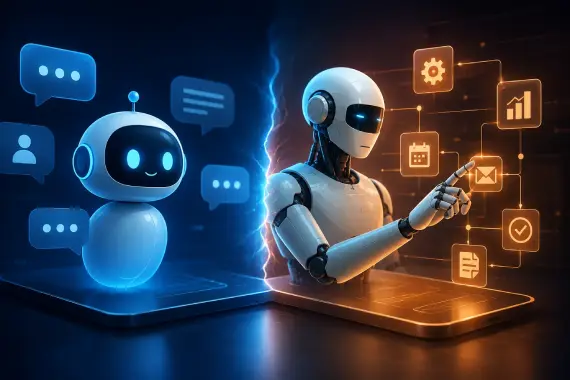
For many use cases, that is exactly what businesses need.
But what happens when the task requires several actions?
AI Agents: From Answers to Actions
Imagine asking an AI:
“Find customers whose subscriptions are about to expire, check their recent interactions, identify high-risk accounts and prepare follow-ups for the sales team.”
This requires more than generating a response.

The system may need to:
- 01Access CRM data
- 02Analyze customer information
- 03Identify patterns
- 04Check previous interactions
- 05Prioritize accounts
- 06Prepare communications
- 07Create follow-up tasks
This is the fundamental difference.
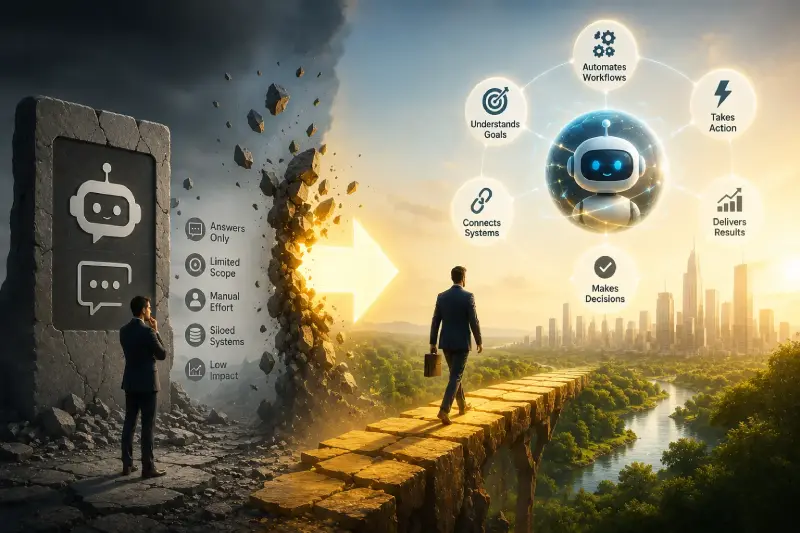
A chatbot primarily answers. An AI agent can work toward a goal.
AI agents can use tools and systems to perform multiple steps within predefined permissions and rules.
Google Cloud’s 2026 AI outlook highlights this movement toward AI agents coordinating increasingly complex business workflows.
AI Chatbots vs AI Agents
The important point is that AI agents are not simply “better chatbots.”
They are designed for a different level of automation.
Where Can Businesses Use AI Agents?
AI agents can potentially support workflows across almost every business function.
Customer Service
An agent could understand a customer issue, retrieve account information, check previous interactions and initiate the appropriate workflow.
Sales
An AI agent could identify leads requiring follow-up, analyze CRM activity and prepare personalized outreach for sales representatives.
IT Operations
Agents can help investigate alerts, collect information from monitoring systems and recommend or perform approved remediation steps.
Human Resources
AI agents can assist with employee queries, onboarding, document collection, interview scheduling and routine HR workflows.
Finance
Agents can assist with invoice processing, expense classification, reconciliation and payment follow-ups.
The opportunity is not simply “add AI.”
It is:
Why Businesses Are Moving Beyond Chatbots
The biggest reason is simple:
Consider a typical business process.
Each step may seem small, but thousands of such transactions can consume significant time.
AI agents can potentially connect these fragmented steps into a more intelligent workflow.
That is where the real enterprise opportunity lies.
Does This Mean Humans Will Be Replaced?
Not necessarily.
The most practical approach is human + AI, rather than human versus AI.
- Repetitive tasks
- Information gathering
- Data processing
- Routine workflows
- Initial analysis
For example, an AI agent might prepare a refund recommendation, while a human approves the final action.
The goal should be useful and controlled autonomy.
Humans can remain responsible for:
- Strategic decisions
- Complex cases
- Sensitive situations
- Exceptions
- High-impact approvals
The goal should not be maximum autonomy.
The Biggest Challenge: Giving AI Access
AI agents become powerful when they can interact with business systems.
But that also creates risk.
action
An enterprise agent may need access to:
Businesses therefore need to answer important questions:
- What can the agent access?
- What actions can it perform?
- When is human approval required?
- Can its actions be monitored and audited?
- What happens when it makes a mistake?
This makes AI agents more than an AI project.
They involve software architecture, cybersecurity, data governance and business-process design.
What About Multi-Agent Systems?
One AI agent doesn't necessarily need to do everything.
Businesses can create specialized agents that work together.
system
Together, these agents can form a larger multi-agent system.
Gartner has identified multiagent systems as one of its strategic technology trends for 2026, reflecting the growing interest in multiple specialized AI agents working together.
Should Every Business Replace Its Chatbot?
No.
Not every problem requires an AI agent.
A chatbot may be the better solution when customers simply need information such as:
An AI agent becomes more valuable when the workflow involves:
The right question isn’t:
“Should we use AI agents?”
It is:
“Which business process would benefit most from intelligent automation?”
How Should Businesses Start?
Businesses don't need to transform everything at once.
A practical approach is:
Identify repetitive workflows
Find processes involving significant manual effort.
Measure the current process
Understand time, cost, errors and business impact.
Identify where AI can help
Focus on removing unnecessary work rather than simply adding AI.
Define boundaries
Specify what the AI can access, decide and execute.
Keep humans involved where necessary
High-risk or sensitive actions should have appropriate approval mechanisms.
Measure the results
Track productivity, cost, accuracy, response time and customer experience.
From AI Tools to AI-Powered Workflows
The first wave of enterprise AI taught businesses how to ask AI questions.
The next wave is about delegating defined tasks to AI.
That doesn’t mean every business process will become autonomous.
Instead, we are likely to see a hybrid model where humans define goals and AI handles more of the repetitive work required to achieve them.
The competitive advantage may therefore come not from simply having access to the latest AI model, but from connecting AI to the right business processes, data and systems.
AI chatbots changed how businesses interact with technology.
AI agents could change how businesses get work done.
The difference is simple:
Businesses that understand this distinction can move beyond using AI as a conversational tool and start exploring AI as part of their operational workflows.
The question for technology leaders is no longer simply:
“Which AI chatbot should we use?”
It is:
“Which business process should we teach AI to handle?”
That may be the more important AI conversation for businesses in 2026.
Frequently Asked Questions
1. What is the difference between an AI chatbot and an AI agent?
An AI chatbot primarily answers questions and generates responses. An AI agent can pursue a defined goal, use tools, access systems and perform multiple actions within approved boundaries.
2. Are AI agents better than AI chatbots?
Not always. Chatbots are excellent for information-based interactions, while AI agents are more suitable for multi-step workflows requiring actions across systems.
3. Can AI agents replace employees?
AI agents can automate repetitive tasks, but businesses still need human judgment, oversight and accountability, particularly for complex or high-risk decisions.
4. What can AI agents be used for?
AI agents can support customer service, sales, IT operations, HR, finance, software development and other repetitive business workflows.
5. What is agentic AI?
Agentic AI refers to AI systems capable of pursuing goals, planning tasks, using tools and taking actions rather than simply responding to individual prompts.
6. What are multi-agent systems?
Multi-agent systems involve multiple specialized AI agents working together to complete more complex tasks or workflows.
7. Are AI agents safe for businesses?
They can be, when implemented with appropriate security, access controls, monitoring, testing, governance and human oversight.
8. Should every business adopt AI agents?
No. Businesses should first identify processes where AI-driven automation can deliver measurable value.
Ready to move beyond AI chatbots?
If your business has repetitive processes involving multiple systems, manual decisions or recurring tasks, AI-powered workflows could help you improve efficiency and reduce operational effort.
Talk to Nispaara Solutions