
AI Agents in 2026: What Businesses Should Know Before Giving AI Autonomy
AI has already changed how businesses work.
But something much bigger is happening now.
Who is actually in control?

Traditional AI tools wait for people to give them instructions. AI agents are being designed to take the next step themselves.
They can reason through a task, access information, use software, make decisions within defined boundaries and execute actions across business workflows.
That changes the question businesses need to ask.
to directing AI.
What Exactly Is an AI Agent?
A simple AI assistant responds to a request.
An AI agent goes further.
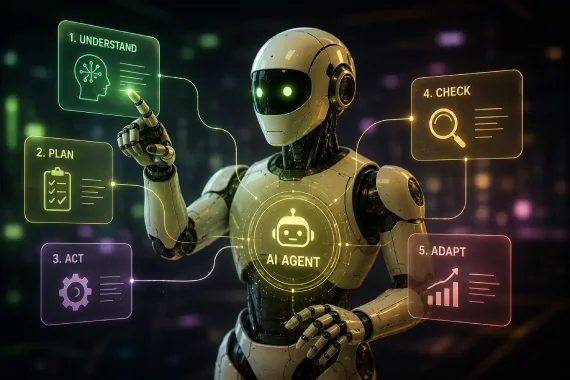
Why AI Agents Matter to Businesses in 2026
AI agents could change how organisations handle repetitive and multi-step work.But there is an important distinction:
Automation is not the same as autonomy.

03 / THE RISK
The Real Risk: Giving AI Too Much Access
Imagine an AI agent that can access your CRM, email, customer database and internal documents.
It may be incredibly useful.
The problem can be the permissions surrounding it.
04 / THE CONTROL PLANE
Before Giving AI Autonomy, Define the Boundaries
Businesses should establish clear boundaries before allowing an AI agent to take independent action.
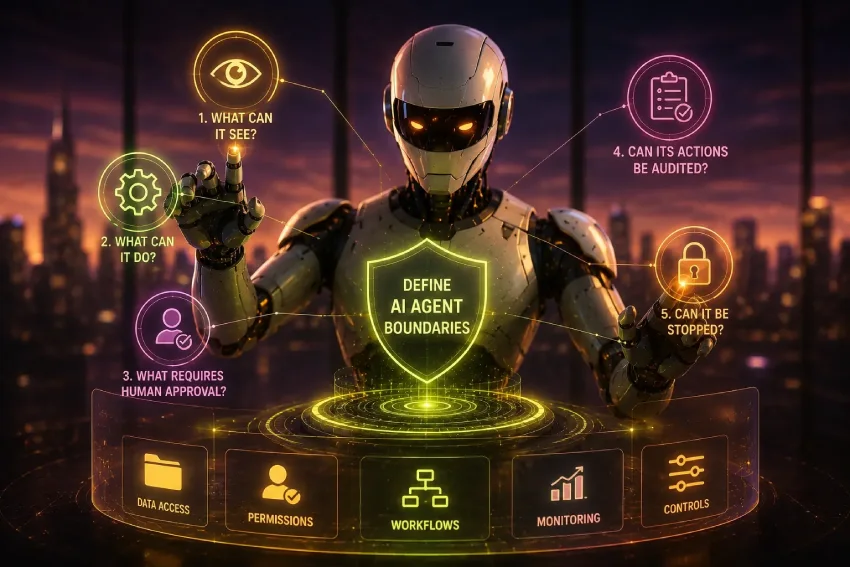
AI Agents Need the Right Digital Infrastructure
This is where AI adoption becomes more than simply purchasing an AI tool.
A modern business website is no longer just a digital brochure. It can connect marketing, CRM, analytics, content, lead generation, customer communication and business workflows.
Don't Give AI Unlimited Autonomy
The better objective is:
“Let AI do the right things within clearly defined boundaries.”
Drafting content
Summarising information
Categorising data
Generating internal reports
Updating CRM records
Prioritising leads
Sending routine communications
Triggering internal workflows
Financial transactions
Sensitive customer decisions
Legal or regulatory actions
Irreversible business actions
What Should Businesses Do Before Deploying AI Agents?
Use this simple checklist:AI Agents Should Work With Your Business — Not Around It
One of the biggest mistakes businesses can make is deploying AI agents as isolated tools.
The better approach is to connect them with the systems already running the business.
This creates a connected digital workflow instead of another disconnected application.
Gartner’s 2026 research specifically highlights enterprise integration as a critical requirement because agents need access to applications and data to reason and act effectively.
The Businesses That Win With AI Agents Will Not Be the Ones That Automate Everything
They will be the ones that know what to automate, what to control and where humans still matter.
Agentic AI is moving enterprise software toward outcome-based workflows. Gartner notes that agents can increasingly execute tasks across multiple systems, potentially reducing the need for users to interact with traditional software interfaces.
That means businesses need to rethink not only AI adoption, but also their websites, software, integrations, data architecture and digital customer journeys.
The future isn’t simply about adding AI to existing technology. It is about designing digital systems that are ready for AI to work within them.
Frequently Asked Questions
What are AI agents?
AI agents are AI-powered systems designed to understand objectives, reason through tasks, use tools or applications and take actions with varying levels of autonomy.
What is the difference between AI agents and generative AI??
Generative AI primarily creates content such as text, images or code in response to prompts. AI agents can go further by planning and executing multi-step tasks using connected tools and systems.
Are AI agents safe for businesses?
AI agents can be used safely when organisations establish appropriate permissions, security controls, human oversight, monitoring and clear boundaries around what agents can access and do.
Should businesses give AI agents full autonomy?
No. Autonomy should be based on the risk of the task. Low-risk activities may be automated, while high-impact or irreversible actions should generally include human oversight.
What can AI agents automate?
AI agents can potentially automate customer support, lead qualification, data analysis, IT workflows, software development, document processing, marketing tasks and other multi-step business processes.
Do AI agents need access to business data?
Many useful AI-agent workflows require access to business data or applications. However, access should follow the principle of least privilege, giving an agent only the information and permissions necessary for its task.
Are AI agents relevant to websites?
Yes. AI agents can interact with websites, CRM systems, analytics, content platforms and other digital systems. This makes AI-ready website architecture, APIs, structured content, performance and secure integrations increasingly important.
How can a business start using AI agents?
Start with one well-defined, measurable workflow. Assess the data and permissions required, establish human oversight, test the workflow and monitor the agent before expanding its autonomy.
The Businesses That Win With AI Agents Will Not Be the Ones That Automate Everything
They will be the ones that know what to automate, what to control and where humans still matter.