
AI vs AI: The Cybersecurity Battle Has Changed in 2026
When attackers use AI to move faster, cybersecurity teams are turning AI into their first line of defense.
Read the reportCybersecurity has entered a new phase.
For years, the battle was largely humans vs. machines—security teams trying to detect phishing, malware, vulnerabilities and suspicious activity before attackers could exploit them.
In 2026, the equation is changing.
AI Has Become a New Cybersecurity Weapon
AI doesn’t necessarily create entirely new types of cyberattacks. Instead, it makes existing attacks faster, more scalable and harder to detect.
This is different from a traditional chatbot.
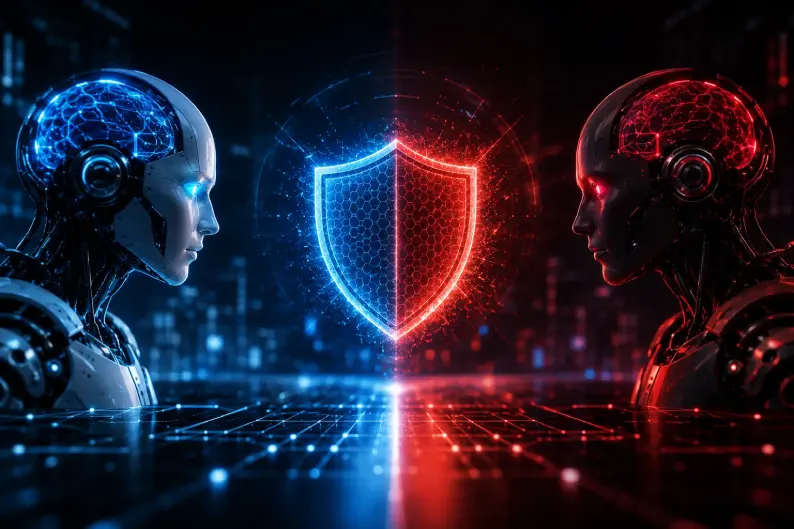
According to CrowdStrike’s 2026 Global Threat Report, AI-enabled adversary activity increased by 89% year over year. The report also found that the average eCrime breakout time fell to 29 minutes, with the fastest observed breakout taking just 27 seconds.
AI can help attackers:
- Automate reconnaissance and vulnerability discovery
- Generate convincing phishing and social-engineering content
- Analyze stolen information at scale
- Adapt attacks based on responses
- Exploit legitimate AI and development tools
- Accelerate movement across cloud and identity environments
This means security teams can no longer rely entirely on slow, manual investigation.
The attacker may already be operating at machine speed.
But AI Is Also Becoming the Defender
The same technology that helps attackers can give defenders a significant advantage.
AI-powered cybersecurity systems can continuously analyze enormous amounts of security data, identify unusual behavior and prioritize threats that deserve immediate human attention.
Instead of asking a security analyst to manually investigate thousands of alerts, AI can help answer:
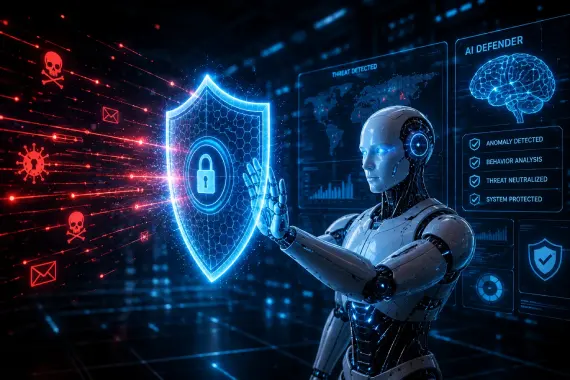
AI can support:
- Threat detection and behavioral analysis
- Automated alert investigation
- Vulnerability prioritization
- Phishing and identity-threat detection
- Incident response
- Security monitoring across cloud and SaaS environments
- Automated remediation of certain threats
Microsoft’s 2025 Digital Defense Report similarly described AI as both a cybersecurity vulnerability and a defensive advantage, highlighting applications such as threat analytics, vulnerability discovery, detection validation and automated remediation.
The goal isn't necessarily to replace security professionals.
It is to give them more intelligence—and less noise.
The New Battlefield: AI Systems Themselves
Here’s where cybersecurity becomes even more complicated.
Businesses aren’t only using AI to defend their infrastructure.
They are increasingly building AI into their infrastructure.
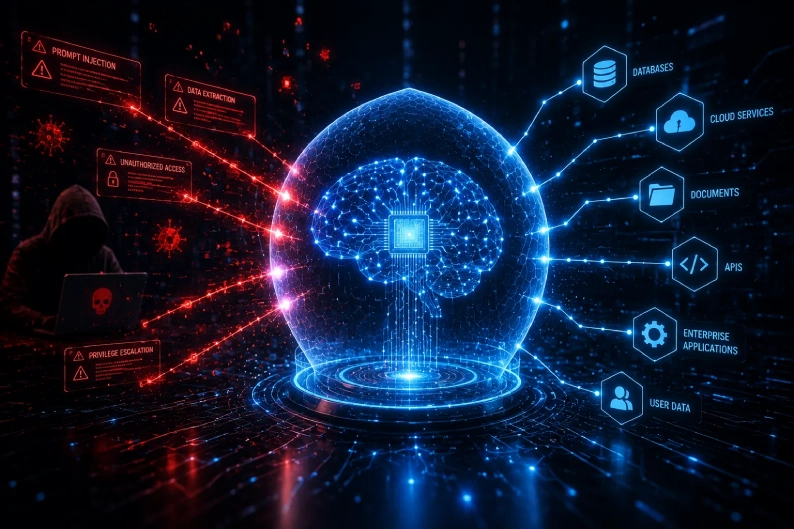
AI agents can access applications, databases, documents, APIs and business workflows. If these agents are poorly secured, they create an entirely new attack surface.
Gartner’s 2026 threat analysis identifies AI application compromise as a critical threat, with risks extending to enterprise AI applications, custom agents and third-party integrations. It also highlights prompt injection as a major concern.
Why Traditional Cybersecurity Alone Is No Longer Enough
Traditional security controls remain essential. Firewalls, endpoint protection, identity management, encryption and vulnerability management aren’t disappearing.
But the attack surface is expanding.
This requires security strategies that understand behavior, not just known threats.
Organizations should increasingly focus on:
- Continuous monitoring
- Zero-trust access
- Least-privilege permissions
- AI-specific threat testing
- Strong identity controls
- Runtime monitoring for AI agents
- Human oversight for high-risk decisions
- Security testing throughout the AI development lifecycle
Gartner’s 2026 cybersecurity guidance emphasizes AI, identity risks, cryptographic change and automation as important areas for security leaders to address.
The Future Isn't AI vs Humans. It's AI + Humans vs AI.
The biggest misconception about AI-powered cybersecurity is that businesses need to choose between automation and human expertise.
They don’t.
The strongest security model is likely to combine both.
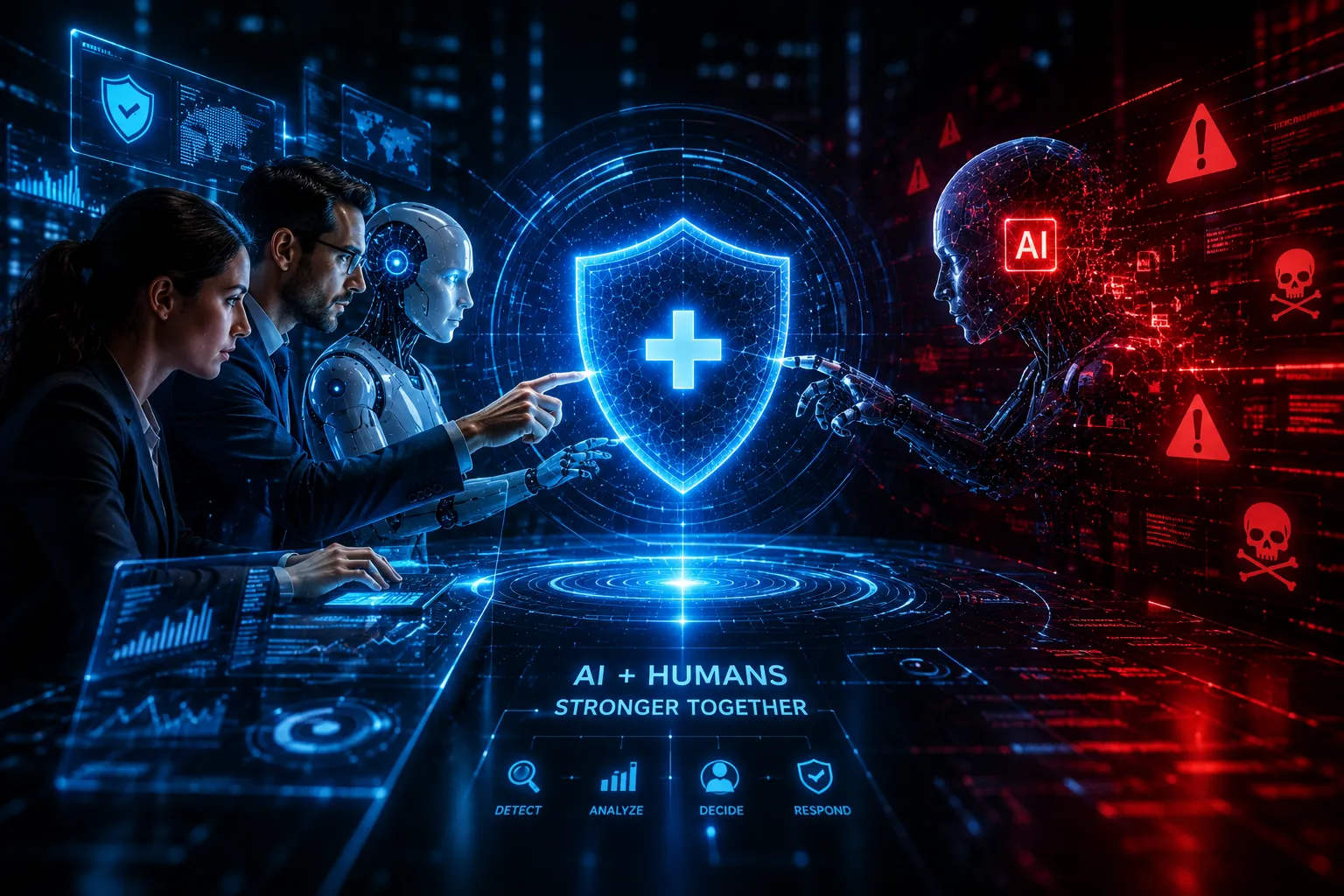
AI can monitor continuously, process enormous datasets and respond to routine threats at machine speed.
Human experts provide context, judgment, strategic decisions and accountability.
For organizations adopting AI at scale, cybersecurity can no longer be an afterthought.
The companies that win the AI era won’t simply be the ones that adopt AI fastest. They’ll be the ones that can adopt it securely.
How Businesses Can Prepare for AI-Powered Cyber Threats
Know Where AI Is Being Used
Identify every AI model, tool, agent and third-party AI service operating inside the organization.
Control AI Access
Give AI agents only the permissions they actually require.
Monitor AI Activity
Track unusual prompts, tool usage, data access and agent behavior.
Test AI Before Attackers Do
Use security testing and adversarial assessments to identify weaknesses such as prompt injection and data leakage.
Keep Humans in the Loop
High-impact actions should have appropriate approval and oversight.
Automate the Right Responses
Let AI handle repetitive investigation and low-risk response actions while humans focus on complex incidents.
The AI Cybersecurity Race Has Already Started
AI has changed the economics of cyberattacks.
Attackers can automate more. Defenders can analyze more. AI systems themselves have become valuable targets.
The question for businesses in 2026 isn’t simply:
“Are we using AI?”
It is:
“Are we securing the AI we use—and using AI effectively to secure everything else?”
At Nispaara Solutions, we believe the future of cybersecurity will combine intelligent automation, strong security architecture and human expertise to help businesses stay ahead of an increasingly AI-driven threat landscape.
Because when attacks happen at machine speed, defense needs to think at machine speed too.
Frequently Asked Questions
What does AI vs AI mean in cybersecurity?
AI vs AI refers to the growing use of artificial intelligence by both cyber attackers and cybersecurity teams. Attackers use AI to automate and accelerate attacks, while defenders use AI for threat detection, investigation, prevention and response.
How is AI being used by cybercriminals in 2026?
AI can be used to automate reconnaissance, create convincing phishing content, analyze information, accelerate attacks and help attackers evade traditional security controls.
Can AI defend against AI-powered cyberattacks?
Yes. AI can analyze large volumes of security data, identify suspicious behavior, prioritize threats and automate certain response actions. However, human oversight remains important for complex and high-impact security decisions.
What is prompt injection?
Prompt injection is an attack in which malicious instructions are introduced into an AI system to manipulate its behavior, potentially causing it to reveal information, bypass controls or perform unintended actions.
Why are AI agents a cybersecurity risk?
AI agents can interact with business systems, data, APIs and applications. If an agent has excessive permissions or is manipulated, an attacker may potentially use those authorized capabilities for malicious purposes.
Will AI replace cybersecurity professionals?
AI is more likely to augment cybersecurity professionals than completely replace them. AI can automate repetitive analysis and response tasks, while humans remain important for judgment, investigation, strategy and accountability.
How can businesses improve AI cybersecurity?
Businesses should identify their AI assets, enforce least-privilege access, monitor AI activity, conduct AI security testing, protect sensitive data and maintain appropriate human oversight.
Build a more intelligent defense.
When attacks happen at machine speed, your defense needs to think at machine speed too.
Talk to an expert