
AI-Native Software Development: When AI Writes, Tests and Deploys Your Code
AI is no longer just helping developers write code. It is beginning to participate in the entire software development lifecycle.
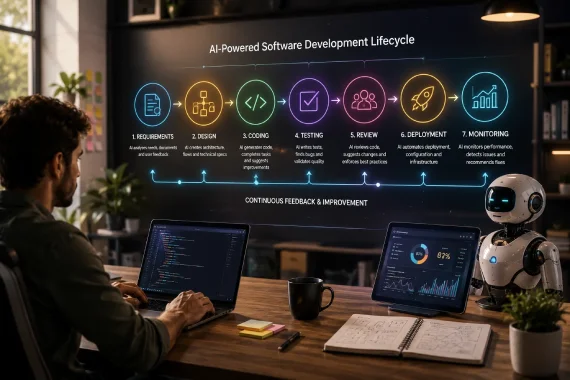
From generating features and fixing bugs to writing tests, reviewing pull requests and supporting deployment workflows, AI coding agents are changing how modern software teams build products. Gartner describes this shift as a move from AI-assisted development toward agent-driven software development across the SDLC.
But if AI can write and test your code, what happens to the role of the developer?
The answer is not that developers disappear. Their role evolves—from writing every line of code to defining requirements, directing AI systems, validating outputs, making architectural decisions and maintaining engineering quality.
What Is AI-Native Software Development?
Traditional software development puts humans at the centre of almost every stage:
AI-native development introduces intelligent systems throughout this workflow:
The difference is significant.
Instead of asking an AI assistant to complete one function, developers can increasingly give an AI coding agent a larger task—such as implementing a feature, investigating a bug or modifying multiple parts of a codebase.
The developer becomes the orchestrator and decision-maker, while AI handles more of the repetitive implementation work.

How AI Is Changing the Software Development Lifecycle
1. AI Writes More Than Code Snippets
AI coding tools have evolved beyond autocomplete.
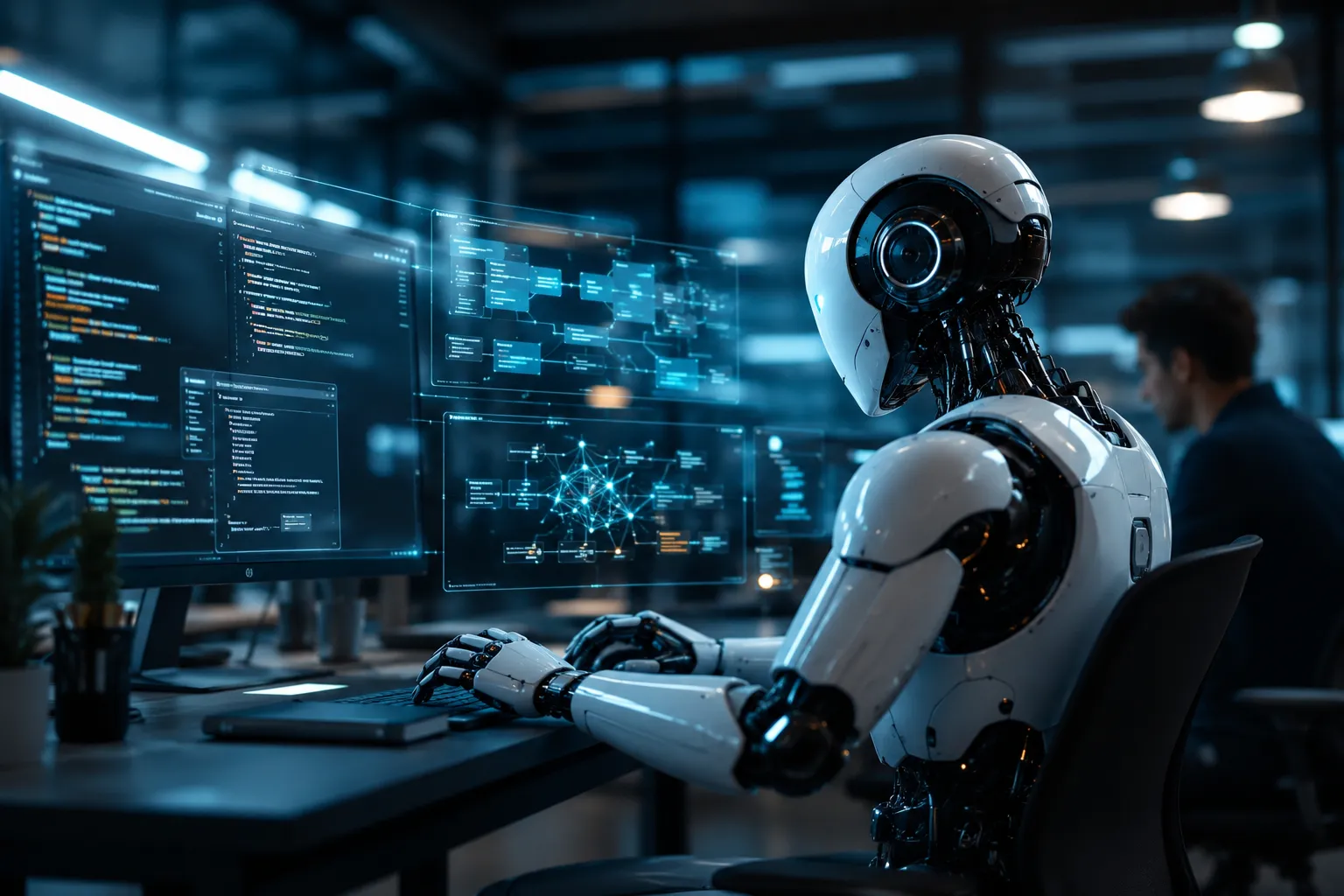
Modern coding agents can understand repositories, create or modify files, investigate errors and work through multi-step development tasks. Gartner's 2026 research describes the enterprise market as moving toward agent-driven development rather than simple code completion.
This means developers can spend less time on repetitive implementation and more time on:
2. AI Becomes Part of Testing
Testing is also changing.
AI can help generate unit tests, identify edge cases, analyse failures and suggest fixes. This can shorten feedback loops and allow developers to test more extensively during development.
However, AI-generated tests should not automatically be treated as proof that software is correct.
A weak test can simply confirm that the code behaves the way the AI expected. Human review, meaningful test coverage and independent validation remain essential.
3. AI Assists With Code Review
Imagine opening a pull request and having an AI system immediately analyse it for:
That does not eliminate human code review. Instead, it can make human reviewers more effective by surfacing potential problems earlier.
4. AI Moves Toward Deployment
The biggest change comes when AI moves beyond the development environment and into CI/CD workflows.
An AI-driven development pipeline could potentially:
This is where AI-native development becomes much more powerful—and much more sensitive.
The more access an AI system has to repositories, infrastructure and production environments, the more important permissions, approvals, auditability and security controls become.

The Developer's Role Is Changing—Not Disappearing
The most important misconception about AI-native development is that “AI writes code, so developers are no longer needed.”
The reality is more nuanced.
As implementation becomes easier, human judgement becomes more valuable.
Research on AI-native software engineering similarly highlights specification, critical evaluation, verification and agent orchestration as increasingly important engineering capabilities.
In other words:
AI may reduce the amount of code humans write, but it increases the importance of knowing what good software looks like.
GUARDRAILS FOR GROWTH
What Businesses Need to Watch Out For
AI-native development brings enormous potential, but moving fast without controls can create new problems.
Security Risks
AI-generated code may introduce vulnerabilities or unsafe dependencies.
Technical Debt
AI can generate large amounts of code quickly. Without architecture and quality standards, technical debt can accumulate just as quickly.
Over-Trusting AI
AI-generated code can look convincing while still being incorrect. Every important output needs appropriate validation.
Access and Permissions
An AI agent with access to source code, CI/CD systems or production infrastructure needs carefully controlled permissions.
Accountability
Businesses must know which AI system changed what, why the change happened and who approved it.
Recent software-quality research reinforces this concern: AI can accelerate delivery, but it can also accelerate technical debt and security exposure when engineering quality is not properly measured and managed.
THE ROAD AHEAD
So, What Does the Future Look Like?
The future of software development is unlikely to be humans versus AI.
It is more likely to be humans working with teams of specialised AI agents.
One agent may analyse requirements. Another may write code. Another may generate tests. Another may review security. Humans remain responsible for business decisions, architecture, governance and final accountability.
That is the real promise of AI-native software development:
Developers spend less time producing code and more time engineering outcomes.
For businesses, the opportunity is not simply to “use AI for coding.” It is to redesign the entire software delivery process around speed, automation, quality and responsible human oversight.
Nispaara Solutions can help businesses evaluate where AI can fit into their software development lifecycle—from application development and automation to modern cloud and AI-powered solutions.
Frequently asked questions
What is AI-native software development?
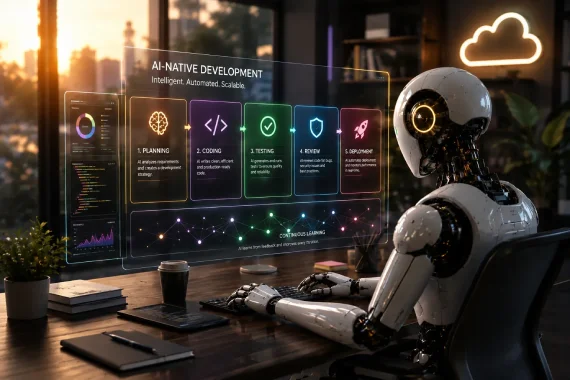
AI-native software development is an approach where AI is integrated throughout the software development lifecycle, including planning, coding, testing, code review and deployment.
Will AI replace software developers?
AI is more likely to change software engineering roles than eliminate them entirely. Developers are increasingly expected to focus on architecture, problem-solving, validation, security and orchestrating AI-assisted workflows.
Can AI write production-ready code?
AI can generate useful production code, but generated code still requires testing, security checks, code review and human validation before being deployed to critical environments.
Can AI test software automatically?
Yes. AI can generate tests, analyse failures, identify potential edge cases and assist with debugging. However, AI-generated tests should be independently reviewed to ensure they provide meaningful coverage.
What are the biggest risks of AI-native development?
The major risks include insecure code, hallucinated solutions, excessive technical debt, insufficient testing, dependency risks, data exposure and excessive AI access to development or production systems.
Is AI-native development suitable for small businesses?
Yes. Smaller businesses can use AI-native development to accelerate application development and automation. However, they should establish appropriate security, testing and access controls before giving AI systems significant autonomy.
The question is no longer whether AI will change software development. It already has.
The bigger question is: How much of your software development lifecycle should AI be trusted to handle—and where should humans remain firmly in control? That balance will define the next generation of software engineering.